
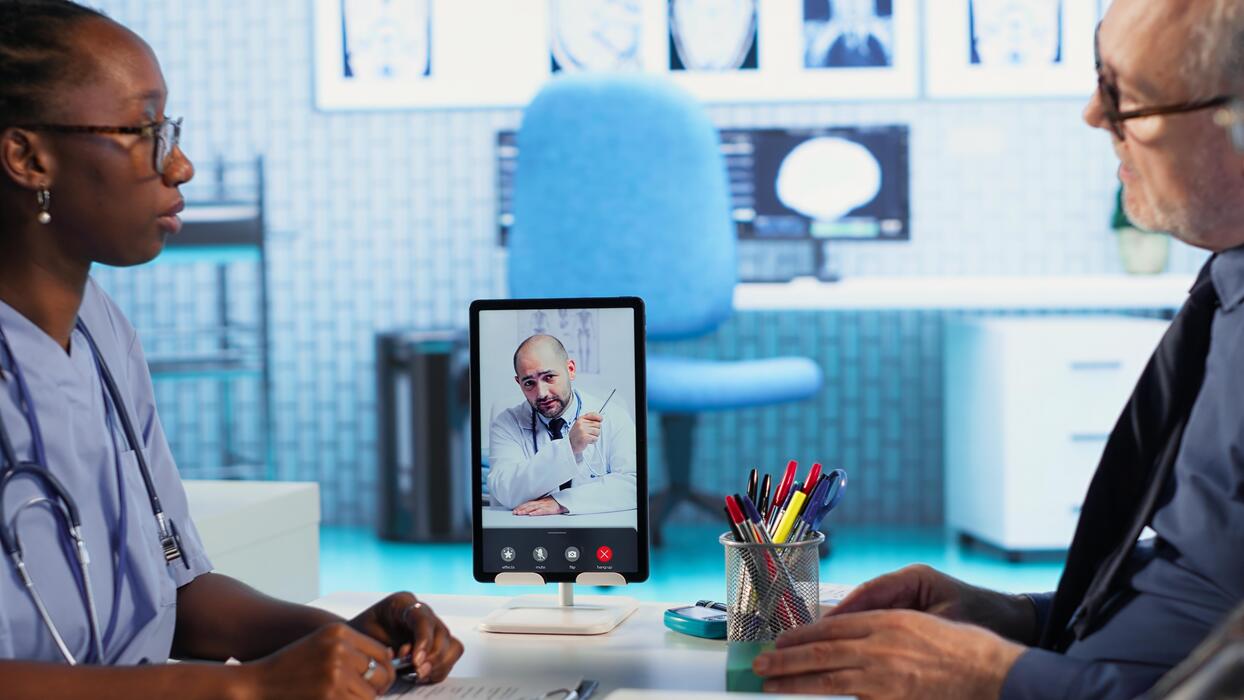
IT Services for Telepsychiatry Providers from a healthcare-only team
For a telepsychiatry group, the video call is not a convenience layered on top of the practice; it is the practice. When a session freezes during a medication review or a risk assessment, you do not just lose a visit, you lose clinical continuity at the moment it matters most. Your clinicians sign in from home offices spread across a dozen states, your patients join from bedrooms and parked cars, and every one of those connections has to be private, stable, and HIPAA-covered end to end. Controlled-substance prescribing for stimulants and other psychiatric medications runs through EPCS with its own identity-proofing and two-factor rules, and the DEA telemedicine flexibilities that make remote prescribing possible are only extended through the end of 2026. Licensure follows the patient, so a clinician credentialed in five states still has to know which state’s law governs each encounter. Your EHR, whether it is Osmind, Valant, SimplePractice, or Kipu, has to carry scheduling, notes, prescribing, and telehealth without dropping a beat. There is no clinic hallway to catch an IT problem, so a laptop that will not connect at 8 a.m. is a full morning of empty slots. Generic managed-service providers treat your video platform as one app among many; we treat it as the whole product. We build the network, the endpoints, and the compliance controls around a single assumption: uptime is patient care. Medical IT Company keeps telepsychiatry providers fast, secure, and online.
why choose us for IT Services for Telepsychiatry Providers
Support built around telehealth reliability, multi-state compliance, and a clinician workforce that never shares an office.
private by default
We wrap your video, messaging, and records in encryption and access controls that assume the connection is the whole practice. HIPAA is the floor, not the goal.
sessions that hold
We engineer the network and failover so a visit does not drop mid-sentence. Backup internet and quality-of-service tuning keep the video steady for the full hour.
clinicians anywhere
We secure home offices, personal devices, and residential Wi-Fi across every state you serve. Your team stays protected whether they log in from a spare bedroom or a rented suite.


more ways we support healthcare





healthcare IT challenges telepsychiatry providers face
The defining challenge is that your revenue, your clinical record, and your patient relationship all travel over one video connection. A dropped call is not an inconvenience to reschedule; it is a broken therapeutic moment and, sometimes, an unmanaged clinical risk. So the network, the video platform, and the failover path have to be engineered for reliability first, with wired connections, backup internet, and quality-of-service tuning that protects the session over everything else on the line.
Then there is the workforce. A telepsychiatry practice has no perimeter to defend because there is no building; care happens from home offices, personal laptops, and residential Wi-Fi in every state you serve. Each of those endpoints is a place protected health information lives, so device encryption, managed antivirus, screen locks, secured home routers, and clear BYOD boundaries are not optional hardening, they are the front door to your entire practice.
Compliance sits on top of all of it. Where the patient is physically located governs the encounter, so multi-state licensure, consent, and prescribing rules shift patient by patient. Psychiatrists rely on state medical licenses and the Interstate Medical Licensure Compact rather than PSYPACT, which covers psychologists, and controlled-substance prescribing depends on EPCS and DEA telemedicine flexibilities that carry firm expiration dates. The technology has to log, encrypt, and prove all of it.
Finally, the EHR and the tools around it have to scale. Osmind, Valant, SimplePractice, and Kipu each connect to telehealth, e-prescribing, messaging, and billing, and every integration is a place data can leak or a workflow can stall. As you add clinicians and states, onboarding, access control, and support cannot become the bottleneck that caps your growth.
telepsychiatry providers IT FAQs
Your practice has no building, so every home office is effectively a branch we have to protect. We encrypt devices, manage antivirus and patching, enforce screen locks and strong authentication, and secure the home routers and Wi-Fi where protected health information travels. For teams using personal laptops, we set clear BYOD boundaries so work data stays contained and separable. Access is scoped to each clinician’s role and revoked the moment someone leaves. That way a distributed workforce does not become a distributed set of open doors.
We treat your video connection as the product, not an app, so it gets engineered for reliability first. That means wired or hardened connections for clinicians, backup internet where it counts, and quality-of-service tuning that prioritizes the session over everything else sharing the line. We monitor the platform and the network so we can see trouble before a patient does. If a home setup is the weak link, we fix the router, the bandwidth, or the device rather than blaming the visit. The goal is simple: the call holds for the full hour, every time.
Most telepsychiatry groups we work with move to a predictable monthly plan priced per clinician or per user, which keeps budgeting simple as you scale. What you pay depends on your headcount, the number of states and platforms you run, and how much compliance and prescribing support you need. That flat fee typically covers monitoring, endpoint security, help desk, EHR and telehealth support, and HIPAA safeguards, so there are no surprise hourly bills when a session breaks at 8 a.m. Compared with the cost of a morning of dropped visits or a compliance lapse, proactive IT is the far cheaper option. We will scope your practice and give you a clear number before you commit.
Yes. Electronic prescribing of controlled substances carries strict DEA requirements, including identity-proofing of the prescriber and two-factor authentication at the moment of signing. We help you stand up and maintain the tokens, credentials, and audit logging your EHR and pharmacy network need to stay compliant. We also track the DEA telemedicine flexibilities that allow remote controlled-substance prescribing, which are currently extended only through the end of 2026. Keeping stimulant and psychiatric refills flowing without a compliance gap is part of the service, not an afterthought.
The encounter is governed by where your patient physically sits, not where your clinician does, so your systems have to capture and respect that. We help configure your EHR and scheduling so patient location, consent, and state-specific requirements are recorded on every visit. We keep the technology aligned as you add states and clinicians, and we log the trail auditors and boards expect. It is worth noting psychiatrists rely on state medical licenses and the Interstate Medical Licensure Compact rather than PSYPACT, which covers psychologists. We build the infrastructure so your compliance team can enforce the rules without fighting the software.
We support the systems built for virtual psychiatric care, including Osmind, Valant, SimplePractice, and Kipu, along with the telehealth, messaging, and e-prescribing tools that connect to them. We handle the integrations so scheduling, notes, prescribing, and billing move together instead of living in disconnected silos. Every connection is configured with HIPAA-grade security and monitored for reliability. If you are switching platforms or adding one, we manage the migration and the data protection around it. You get one secure, coherent stack rather than a pile of apps that barely talk.